
Guides
Alfa Nero: Anatomy, History, and Legal Saga of an Iconic Superyacht
A detailed reference guide to Alfa Nero, the 82-metre Oceanco superyacht known for its pool-to-helipad deck, ownership history, Antigua seizure and legal saga.
By Riviera Yacht Charter Editorial
Published June 2, 2026
24 min read
Executive summary
View the Alfa Nero yacht charter page for live specifications, images and enquiry options.
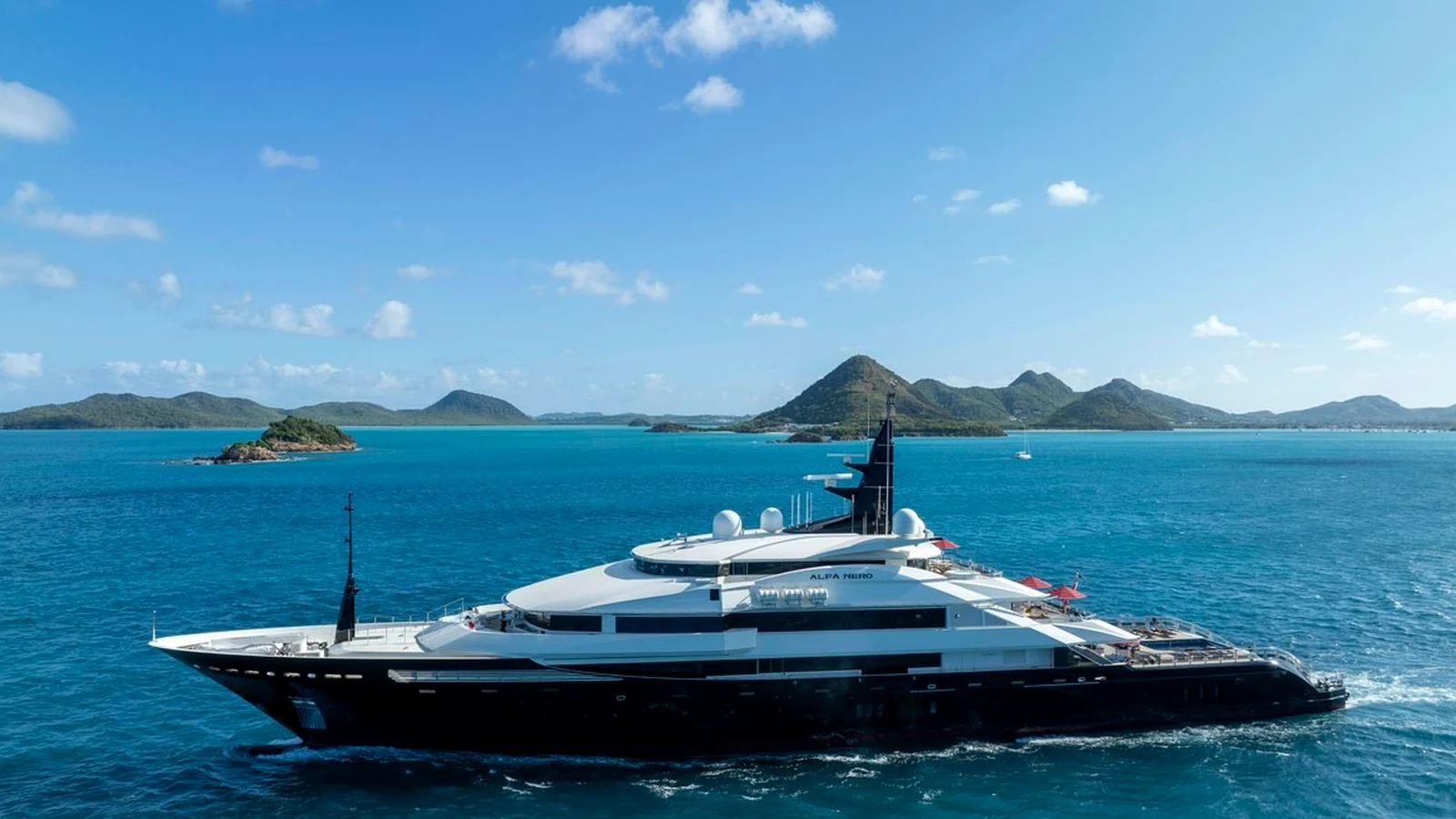
Alfa Nero is an 82-metre Oceanco superyacht that became one of the most recognisable vessels in the global fleet thanks to its radical aft-deck pool-to-helipad design and a multi-year legal and political saga around sanctions and seizure in Antigua and Barbuda. Built in 2007 with exterior design by Nuvolari Lenard and interior by Alberto Pinto, it accommodates around 12 guests and roughly 26-28 crew, cruises near 15-18 knots, and has a transoceanic range exceeding 5,500 nautical miles. The yacht has been linked to high-profile owners, including Greek magnate Theodore Angelopoulos early on and later the family of Russian billionaire Andrey Guryev, which drew it into post-2022 sanctions enforcement.
From 2022 onwards, Alfa Nero lay effectively abandoned in Falmouth Harbour, Antigua, while alleged beneficial owners challenged sanctions and refused to formally claim the vessel, leaving local authorities to shoulder significant upkeep costs and unpaid crew wages. Antigua amended its domestic law to declare the yacht abandoned, seized it, and auctioned it, initially to former Google CEO Eric Schmidt in 2023 and, after subsequent litigation and withdrawal, to an undisclosed buyer around mid-2024. The sale proceeds funded large back-pay awards to crew and left constitutional questions about the legality of seizure and expropriation for higher courts to resolve, while the current owner retains clear title according to Antiguan authorities.
The following report breaks down Alfa Nero as an asset (technical and design profile), traces its ownership and market value, and analyses the legal framework and geopolitical context that turned one yacht into a test case for small-state sanctions enforcement.
1. Technical and design profile
1.1 Core dimensions and layout
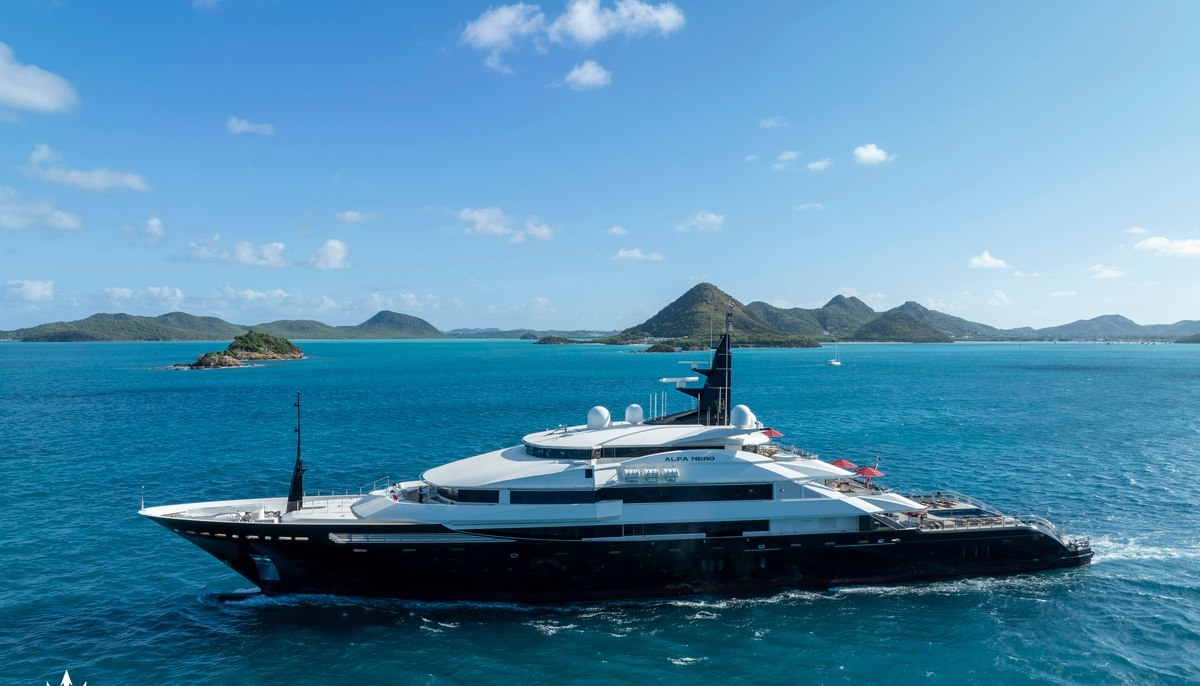
Alfa Nero is a full-displacement steel-hulled motor yacht with aluminium superstructure built by Oceanco at its Alblasserdam facilities and delivered in 2007. The vessel’s principal dimensions place it firmly in the mega-yacht category: length overall approximately 82 m (269 ft), beam around 14.2 m (46.6 ft), and a draft close to 3.9 m (12.8 ft), with a gross tonnage reported in the 2,100-2,500 GT range depending on source and measurement updates.
The yacht is distributed over several decks, including a lower deck, main deck, upper deck, bridge deck, and sun deck, with internal volume of roughly 1,200-1,250 m² of guest and entertainment space. Guest accommodation typically covers 6-7 staterooms for 12 guests on commercial charter, while crew accommodation runs to roughly 26-28 berths plus service spaces.
1.2 Propulsion, performance and range
Propulsion is provided by two MTU diesel engines, each in the 4,680-4,880 hp range, coupled to conventional shafts and propellers. This plant supports a maximum speed quoted around 20-21 knots, with a comfortable cruising band roughly 15-18 knots that balances comfort and efficiency.
Range figures published by brokers and registries indicate approximately 5,500-5,760 nautical miles at around 15 knots, placing Alfa Nero firmly in the transoceanic capability bracket and enabling Atlantic crossings without refuelling. The vessel is equipped with modern zero-speed stabilisers to reduce roll both underway and at anchor, a standard feature for yachts at this size and value point.

1.3 Exterior architecture and signature pool deck
The exterior design by Nuvolari Lenard was widely regarded as evolutionary when Alfa Nero launched, with a pronounced reverse sheer and a strong, swooping superstructure line terminating in an open aft deck. Rather than the typical stepped sun-deck cascade, the architects devoted vast real estate to a single multi-functional aft deck structure.
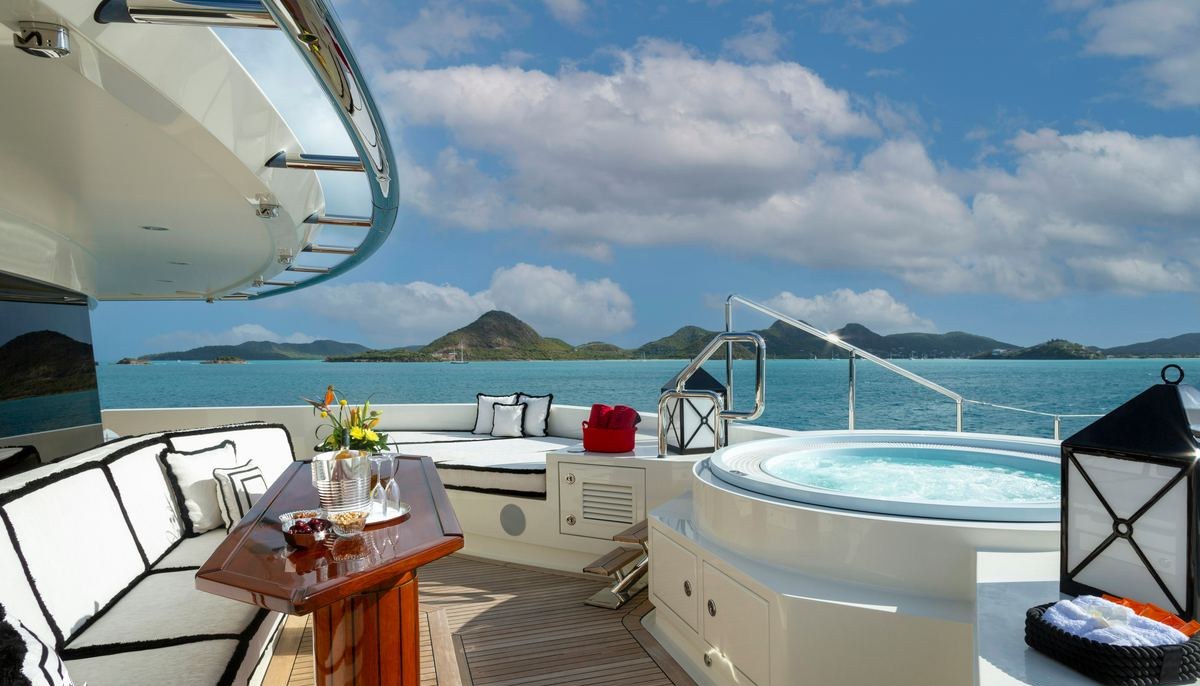
Alfa Nero’s signature feature is the aft infinity pool whose glass transom wall looks out over the sea, bounded by sunpads and lounge areas. The pool’s floor is engineered on a hydraulic platform that can raise to flush-deck level, transforming the pool basin into either a dance floor or a touch-and-go helipad capable of handling medium-size helicopters. This convertible pool-to-helideck concept has since been widely imitated and is often cited as a turning point in large-yacht deck design.
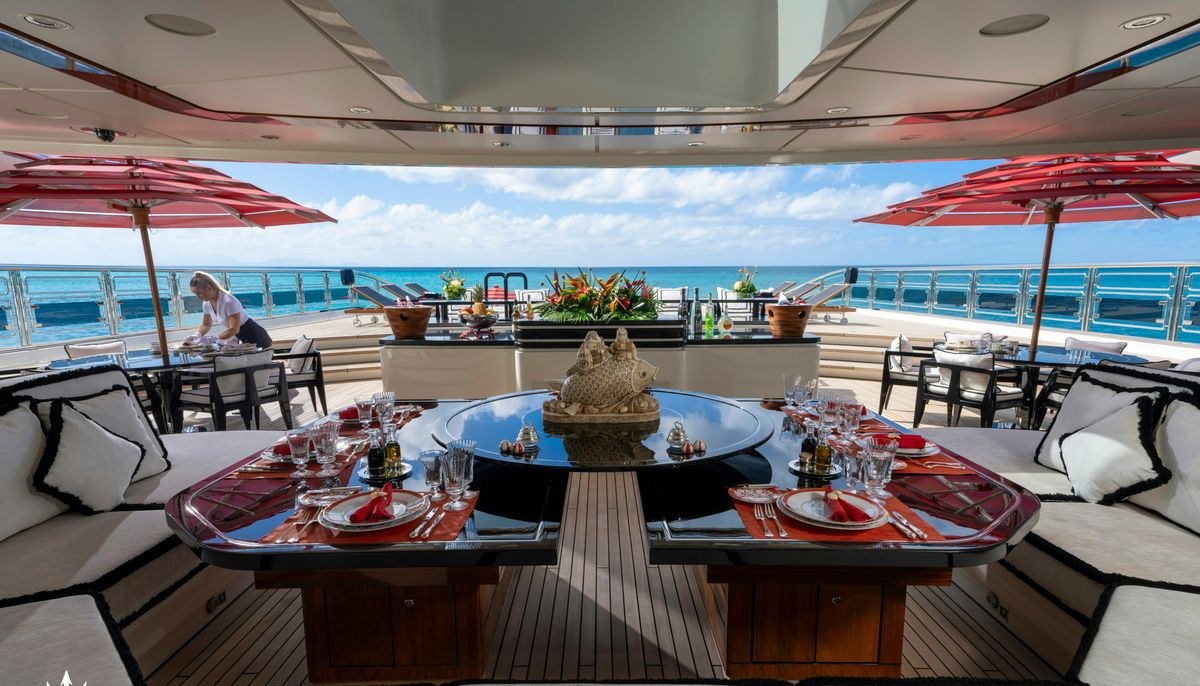
Forward of the pool, the main deck hosts expansive open-air lounging and dining zones designed for Mediterranean use, while upper decks provide additional terraces, a forward observation area, and a protected sun deck. The design aims to blur interior-exterior boundaries, with large sliding doors from saloons to decks and extensive glazing for sea views.
1.4 Interior design, guest experience and amenities
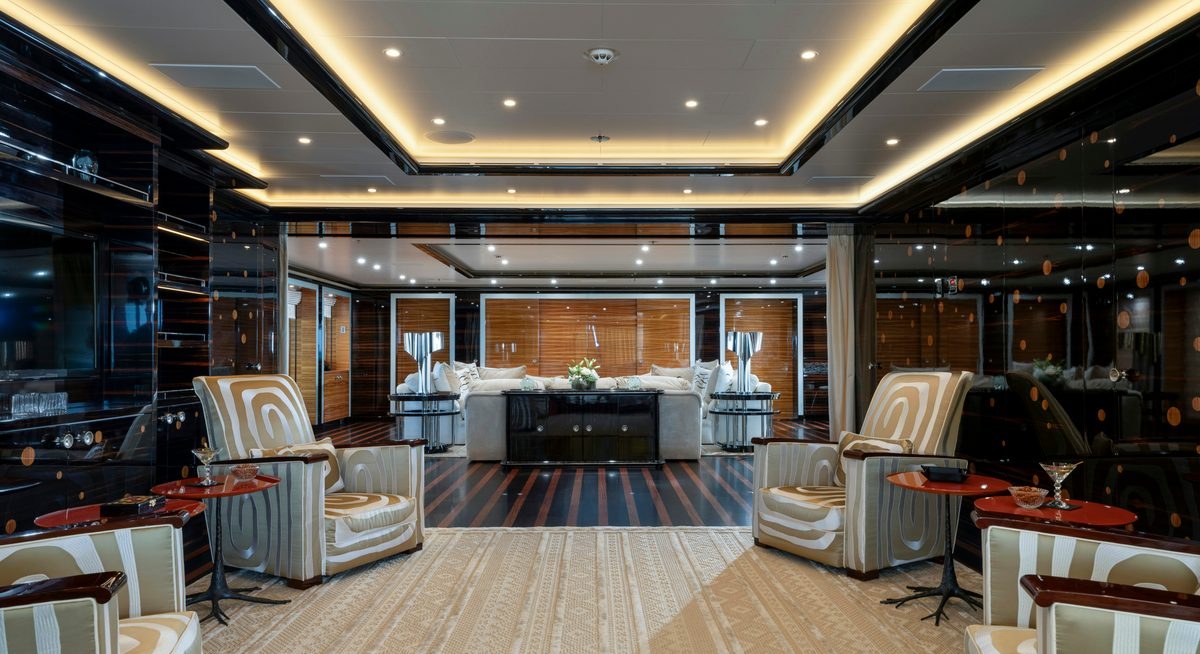
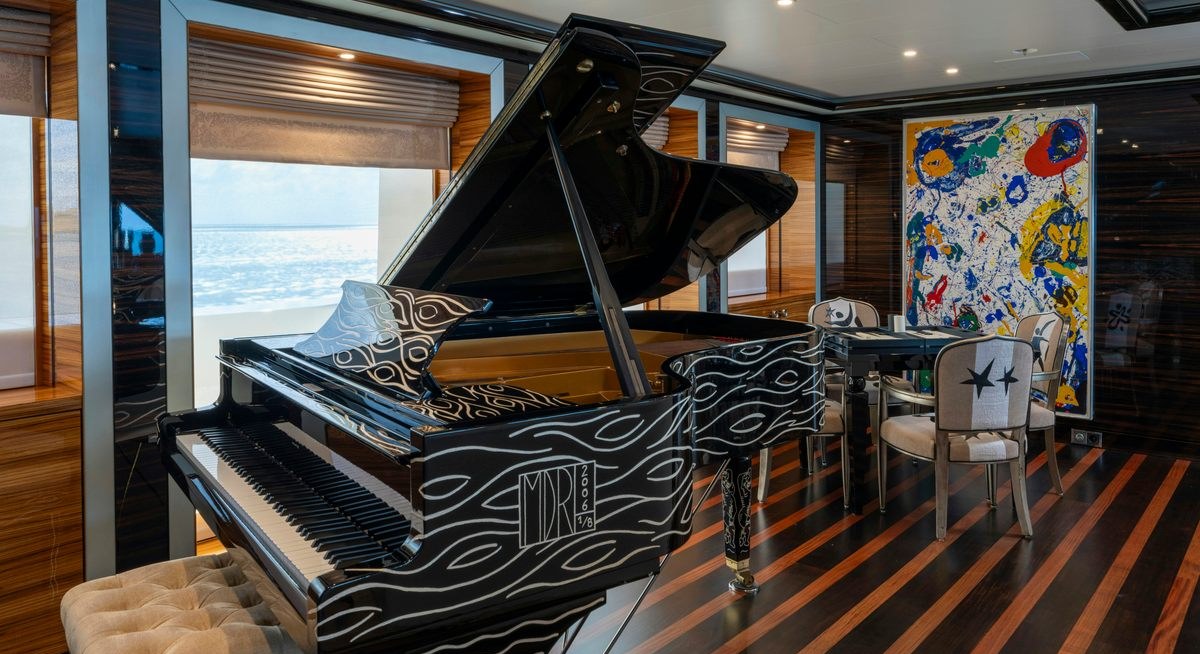
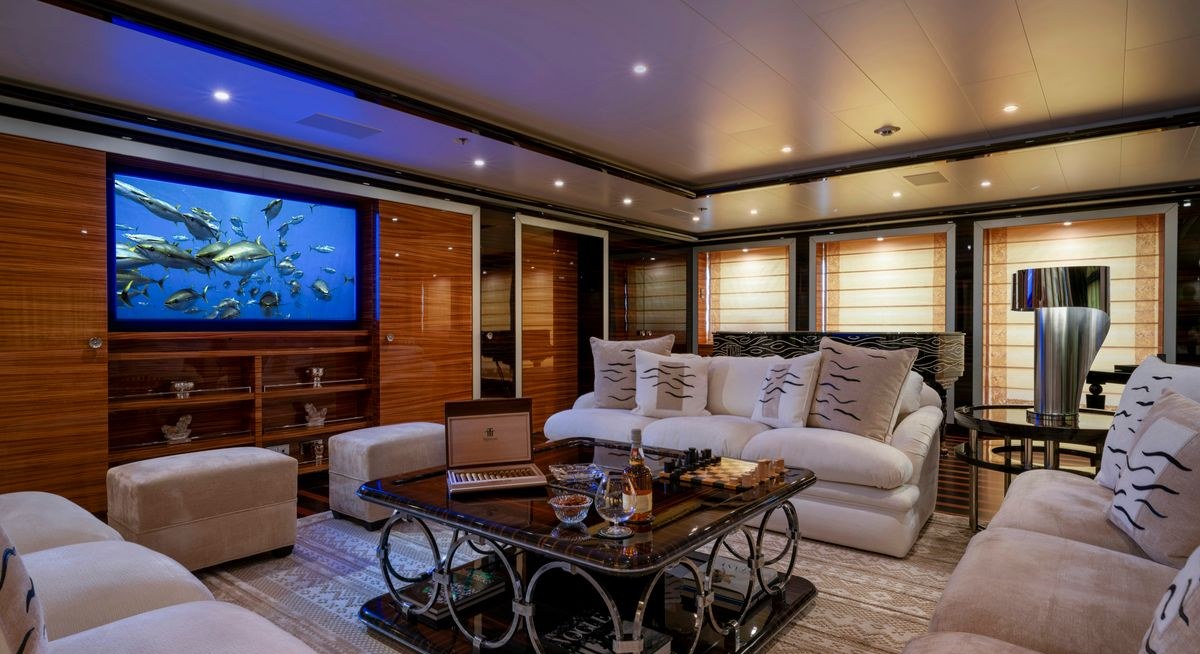
The interior by Alberto Pinto combines classical luxury elements with contemporary lines, leveraging high-end woods, marbles and soft furnishings across multiple saloons and guest areas. Early coverage highlighted a neutral and sophisticated palette in guest spaces contrasted with more personalised luxury in the owner’s suite.
The typical layout places the master or owner’s suite forward on the upper deck, often configured as a full-beam apartment with a private study or office, dressing room, and direct access to an intimate foredeck terrace that can include a private spa pool or seating area. Additional guest cabins, including a VIP suite and several double or twin staterooms, sit mainly on the main deck to maximise window size and ease of circulation.
- Amenities include:
- A dedicated cinema or media room.
- A full-fledged gym/fitness space, frequently noted as located on the bridge deck with panoramic views.
- A wellness area incorporating sauna, steam room and massage facilities.
- An elevator serving guest decks for accessibility and convenience.
- A beach club environment integrated with the aft pool deck and swim platform, supporting tenders and watersports.
1.5 Charter configuration and 2024 refit
Alfa Nero has often been available for charter, with brokers marketing her as a high-end, 12-guest platform with seven staterooms and 28 crew, offering a high crew-to-guest ratio. The charter package emphasises the pool-helipad, wellness facilities, gym, cinema, and extensive outdoor dining and lounging areas.
Broker listings describe a 2024 refit that refreshed interiors, updated technical systems and ensured continued class and commercial compliance, particularly important after a prolonged lay-up during the Antigua dispute. Following refit, she remains classed with Lloyd’s Register and registered under the Maltese flag, one of the standard registries for large yachts intended for commercial use.
2. Ownership history and market valuation
2.1 Original commissioning and early ownership
Alfa Nero was ordered in the mid-2000s during a period of rapid expansion in the high-end yacht market, when shipyards such as Oceanco were carving out a niche in 70-90 m custom builds. Public records and yacht-tracking sites attribute early beneficial ownership to Greek shipping and steel magnate Theodore Angelopoulos, although detailed corporate structures have not been fully disclosed.
The vessel’s name, referencing the Roman emperor Nero, fits a period trend of grandiose or classically themed names among very large yachts, reinforcing an image of power and opulence. From launch, Alfa Nero was positioned as a showpiece in the global fleet, often featured at Monaco Yacht Show and similar events as an example of cutting-edge design.
2.2 Transition to Russian-linked ownership
Over time, investigative reporting and yacht-watching sites began linking Alfa Nero to Russian billionaire Andrey Guryev and his family, despite the yacht being formally owned through corporate vehicles. Superyachtfan and similar databases identify Guryev as the effective owner or ultimate beneficial owner (UBO) after the Angelopoulos period, although these identifications generally rely on compiled open-source data.
Guryev, known for his stake in fertilizer producer PhosAgro, was later sanctioned by the United States, United Kingdom, and European Union after Russia’s 2022 invasion of Ukraine, which placed any assets linked to him under scrutiny. Regulators and media thus treated Alfa Nero as one of several “Russian superyachts” potentially subject to asset freezes, though ownership disputes would later complicate this designation.
2.3 Value estimates and operating economics
Prior to sanctions, the yacht’s market value was generally placed in the 80-120 million USD range by industry commentators and sale speculation, reflecting her size, pedigree shipyard, and iconic status. Replacement cost for a new build of similar specification from a top-tier yard would likely be higher, given cost inflation and evolving regulatory standards, though exact figures are not published.
Annual operating costs for superyachts are commonly estimated at 8-12% of build or market value, which for an 80-120 million USD vessel implies typical annual spend in the high single-digit million range. Specific reporting from Antigua’s government emphasised that weekly maintenance while in lay-up was consuming tens of thousands of dollars in security, crew, fuel and port services-substantial relative to the island’s national budget.
2.4 Liquidity events: auction bids and sale price
The June 2023 government-run auction in Antigua saw former Google CEO Eric Schmidt emerge as the highest bidder with an offer in the region of 67 million USD according to multiple reports, though precise disclosed numbers vary. This valuation, below some pre-sanctions estimates, reflected sanction-tainted status, legal risk, and the need for refit after lay-up rather than a straightforward market transaction.
Schmidt ultimately withdrew after it became clear that legal challenges from alleged beneficial owner Yulia Guryeva-Motlokhov and associated entities would delay or complicate transfer of clear title. Subsequent reporting indicates that the yacht was later sold around July 2024 to an undisclosed buyer, widely described as Turkish-linked, for a price around 40 million USD through broker Northrop & Johnson. This represented a steep discount to earlier estimates but allowed Antigua to exit the costly holding position.
3. Sanctions context and “abandonment” in Antigua
3.1 Arrival and lay-up in Falmouth Harbour
Following Russia’s full-scale invasion of Ukraine in February 2022, numerous large yachts associated with Russian nationals relocated to jurisdictions perceived as safer or less likely to enforce Western sanctions. Alfa Nero came to rest in Falmouth Harbour, Antigua, where it remained for well over a year with minimal movement and no public declaration by an owner.
Media and official statements describe the vessel as essentially abandoned: running lights maintained, some crew retained, but no evident commercial activity or owner direction. Despite this, the yacht continued to incur port fees, security costs, bunker fuel for generators, and crew expenses, initially borne by the owners or management and then increasingly by the Antiguan authorities as payments fell into arrears.
3.2 Sanctions designation and asset freeze logic
The United States and other Western actors had sanctioned Andrey Guryev and various family members and entities, alleging close ties to the Russian state and benefiting from state-linked industries. While Alfa Nero itself was not always individually listed, its association with a sanctioned individual through beneficial ownership made it a candidate for seizure or asset freeze under sanctions enforcement frameworks.
Antigua and Barbuda, as a small Caribbean state, faced pressure to align with international sanctions regimes but also had to navigate its own constitutional and property-rights framework. The presence of a large, high-maintenance asset with contested ownership presented both an enforcement challenge and an opportunity to assert sovereignty and offset costs through eventual sale.
3.3 Legislative changes enabling seizure
In 2023 the government of Antigua and Barbuda amended its Port Authority Act to specify procedures for dealing with abandoned vessels, including those linked to sanctioned individuals. Under the amendments, if a vessel remained in Antiguan waters for a specified period without an active, legally recognised owner taking responsibility and after notices were properly published, the government could declare it abandoned and vest ownership in the state.
The government gave public notice in early 2023 stating that if no owner came forward within ten days, the vessel would be considered abandoned and seized; according to officials, no valid claim was lodged within that time frame that satisfied documentation requirements. Based on this, Antigua declared Alfa Nero abandoned and transferred title to the government, paving the way for auction.
4. The Antigua auction process
4.1 Auction design and transparency measures
Antiguan authorities, including the Port Authority and the Prime Minister’s office, emphasised the need for a transparent auction both to reassure the domestic public and to demonstrate good governance to international partners. They pledged that the process would be televised, open to qualified bidders, and properly documented.
Reporting from local media describes a live, televised auction held in June 2023, with Port Manager Darwin Telemaque and other officials overseeing the process. The transparency push was intended to counter perceptions of back-room dealing and to bolster the legitimacy of the sale given the highly politicised nature of sanctions-related asset disposals.
4.2 Eric Schmidt’s winning bid and its aftermath
At the auction, Eric Schmidt was identified as the highest bidder, offering roughly 67 million USD for the yacht, pending resolution of any legal objections and confirmation of clear title. International media quickly reported that Schmidt had effectively “bought” the yacht, presenting the transaction as a done deal.
However, this narrative soon collided with legal challenges mounted by counsel for Yulia Guryeva-Motlokhov, who claimed beneficial ownership and argued that the yacht had been unlawfully seized. Litigation in Antigua and other jurisdictions questioned the constitutionality of the amended Port Authority Act and the adequacy of notice and due process given to the purported owners.
Faced with the prospect of protracted legal battles and uncertainty over when and whether he would receive clear, unencumbered title, Schmidt ultimately withdrew, and the initial sale did not complete. This left Antigua once again bearing maintenance costs and under pressure to find a path forward.
4.3 Second sale and closing with a new buyer
Following further legal manoeuvring and court proceedings, Antigua moved again to finalise a sale. In 2024 the government announced that a new buyer had been found through broker Northrop & Johnson, widely reported as a Turkish-linked purchaser, at a significantly lower price point of around 40 million USD.
The Antigua Port Authority’s CEO Darwin Telemaque later stated that any remaining court decisions, including potential rulings on compensation to previous owners, would "have nothing to do" with the validity of the yacht’s sale to the new owner and would not result in reversal or re-auction. In essence, the government framed any residual litigation as a question of whether the state owed damages, not whether the current owner’s title was secure.

5. Crew wages and maritime labour rights
5.1 Crew abandonment and unpaid wages
During the period when Alfa Nero lay in Falmouth Harbour, the crew continued to provide security, maintenance and basic vessel care, often without timely payment of wages and with uncertain futures. Maritime unions and NGOs classify such situations as “crew abandonment”, a recognised issue in international maritime labour law.
As invoices went unpaid, the crew and their union, Nautilus International, turned to legal remedies, effectively arresting the vessel in rem (against the ship itself) for claims of unpaid wages and costs. This approach leverages longstanding maritime law principles that treat ships as security for maritime liens, including crew wages.
5.2 Court rulings and wage settlements
In early 2024 and early 2025, court decisions in favour of the crew confirmed that they were owed more than a year’s wages, with some rulings ordering that proceeds from any sale or from funds held should be used to satisfy these claims. Reports from Nautilus indicated that hundreds of thousands of pounds-around 890,000 GBP in one tranche-were to be paid to crew members as a result.
These cases highlight that, even amid geopolitically charged seizures, traditional maritime labour claims retain priority: crew wages are typically treated as high-priority liens that must be settled before owners or even some state claims on sale proceeds. For Antigua, ensuring that crew were paid also helped mitigate reputational risk in the international maritime community.
5.3 Interaction between crew claims and state seizure
One of the complexities in the Alfa Nero case was the intersection between a state asserting ownership through abandonment/seizure and private crew claims secured by arrest. Courts had to determine the order and mechanism for satisfying these competing interests, balancing sovereign authority with entrenched maritime law doctrines.
Available reporting suggests that Antiguan and other courts allowed crew claims to be met from sale proceeds or from funds earmarked in connection with the yacht, while leaving any compensation to former beneficial owners to be sorted through separate constitutional or civil litigation against the state. This effectively ring-fenced labour claims from the broader geopolitical dispute.
6. Constitutional and legal challenges
6.1 Challenges by Yulia Guryeva-Motlokhov
Yulia Guryeva-Motlokhov, identified as the daughter of Andrey Guryev, challenged Antigua’s actions by asserting that she, or entities she controlled, was the lawful owner of Alfa Nero and that the seizure and sale were unconstitutional expropriations. Her lawyers argued that Antigua’s Port Authority amendments were improperly applied to a specific asset and that due process protections were insufficient.
These challenges raised questions about whether public notices and time periods for owners to come forward were adequate, whether sanctions designations justified the steps taken, and whether foreign pressure influenced domestic legislative changes in ways inconsistent with Antigua’s constitution. In legal terms, the dispute evolved from a simple abandonment case into a test of separation of powers and property rights under Antiguan constitutional law.
6.2 High Court proceedings and possible Privy Council appeal
Reports in early 2024 indicated that Antigua’s government anticipated that the dispute might ultimately be decided by the Judicial Committee of the Privy Council in London, which acts as the final court of appeal for many Commonwealth countries. The government signalled willingness to defend its legislation and actions there if necessary, framing the case as a matter of national sovereignty and the right to deal with abandoned assets.
Legal commentary highlights that a Privy Council ruling on the Alfa Nero case could set precedent on how far small states can go in confiscating and monetising assets linked to sanctioned individuals, particularly when domestic laws are rapidly amended in response to external geopolitical events. Such jurisprudence would be closely watched by other jurisdictions hosting similar assets.
6.3 Separation between sale validity and compensation
Throughout the later stages of litigation, Antiguan officials stressed that court decisions would not unravel the completed sale to the new owner but might determine whether Antigua must compensate former beneficial owners. In other words, they argued that third-party purchasers in good faith should not face claw-back; instead, any remedy would be monetary damages paid by the state.
This position mirrors principles in some asset-forfeiture regimes whereby bona fide purchasers at properly noticed auctions are protected, while disputes focus on whether the state must compensate dispossessed prior owners. If courts uphold this structure, it may encourage buyers to participate in such auctions by reducing title-risk, though at the cost of potential liabilities for the seizing state.
7. Geopolitical and market implications
7.1 Superyachts as sanctions instruments
The Alfa Nero saga underscores how large yachts have become high-visibility instruments of sanctions and political messaging. Seizing or freezing such conspicuous assets sends a signal about enforcement seriousness and can inflict reputational and lifestyle costs on targeted individuals, even if the financial value is modest relative to their total wealth.
At the same time, these seizures can burden host states with substantial upkeep costs and legal complexities, particularly when beneficial ownership is layered through offshore structures and trusts. For small states like Antigua and Barbuda, the decision to seize and sell a high-value yacht entails both potential windfalls and significant legal and diplomatic risk.
7.2 Impact on yacht market liquidity and pricing
Sanctions-tainted yachts like Alfa Nero often trade at a discount to comparable clean assets due to legal risk, reputational concerns, and the need for remedial work after lay-up. The move from a 67 million USD auction bid to a reported ~40 million USD eventual sale illustrates how litigation overhang and asset maintenance issues can erode value over time.
For brokers and buyers, such cases illustrate the importance of robust due diligence on title, sanctions exposure, and potential future litigation, as well as provisions for escrow and risk-allocation in sale contracts. They also highlight opportunities for buyers willing to accept legal and reputational risk in exchange for below-market pricing on globally significant assets.
7.3 Precedent for other jurisdictions
Other Caribbean and Mediterranean jurisdictions hosting large yachts linked to sanctioned individuals are watching the Alfa Nero outcome closely. If Antigua’s legislative approach and subsequent court validation prove durable, similar models for declaring abandoned and auctioning high-maintenance sanctions-linked assets may proliferate.
Conversely, if higher courts criticise aspects of the process-such as insufficient notice, retroactive law-making, or inadequate separation of powers-states may need to craft more cautious, procedurally robust frameworks before touching similar assets. Either way, Alfa Nero has already become a reference point in sanctions and maritime law discussions.
8. Current status and outlook
8.1 Operational condition and commercial positioning
As of late 2024 and into 2025, Alfa Nero is marketed by major brokers as a fully operational, Lloyd’s-classed, commercially compliant superyacht flying the Maltese flag, with a 2024 refit underpinning her technical and aesthetic condition. Listings emphasise her iconic status, pool-helipad, spa, gym, cinema, elevator and generous deck spaces, targeting ultra-high-net-worth individuals seeking a proven charter-capable platform.
Charter narratives present Alfa Nero as both a design classic and a modernised asset, leveraging its relatively small number of owners and Oceanco pedigree as selling points. The yacht’s legal history is typically downplayed in marketing materials, though it remains widely known among industry professionals and informed clients.
8.2 Ongoing legal tail risk for the state
While Antiguan officials insist that the yacht’s current owner faces no risk from pending or future court decisions, the state may still confront claims for compensation depending on how higher courts evaluate the constitutionality of the seizure. If courts find that property rights were infringed without sufficient justification or process, the government could be ordered to pay damages, potentially offsetting fiscal gains from the sale.
For Antigua, this risk sits alongside reputational considerations: being seen as a jurisdiction that balances sanctions enforcement with rule-of-law safeguards is important for maintaining its position in tourism, financial services, and yacht services. A carefully reasoned final judgment could help clarify the legal framework and provide guidance for future cases.
8.3 Alfa Nero as a case study
Beyond its physical specifications and aesthetic appeal, Alfa Nero now serves as a multi-disciplinary case study at the intersection of luxury asset management, sanctions policy, small-state sovereignty, and maritime labour law. Law schools, policy think-tanks, and maritime institutes can use it to illustrate how complex ownership structures, geopolitical shocks and domestic constitutional frameworks interact around a single asset.
For the superyacht industry, Alfa Nero is a reminder that high-profile design can become inseparable from regulatory and political risk profiles. For buyers, charterers and crew, it underlines the importance of understanding not only a yacht’s lines and amenities, but also the legal, operational, and reputational history behind the vessel.